
Table of Contents
- Trump Rejects Iran Ceasefire Deal
- Why Iran’s Proposal Was Rejected
- The Strait of Hormuz Crisis Explained
- Israel’s Position and Netanyahu’s Warning
- Why Global Oil Markets Are Panicking
- Iran’s Nuclear Program Remains the Core Issue
- Historical Comparison: The Tanker War of the 1980s
- Economic Fallout Across the World
- What Happens Next in the Middle East Crisis?
- Final Analysis
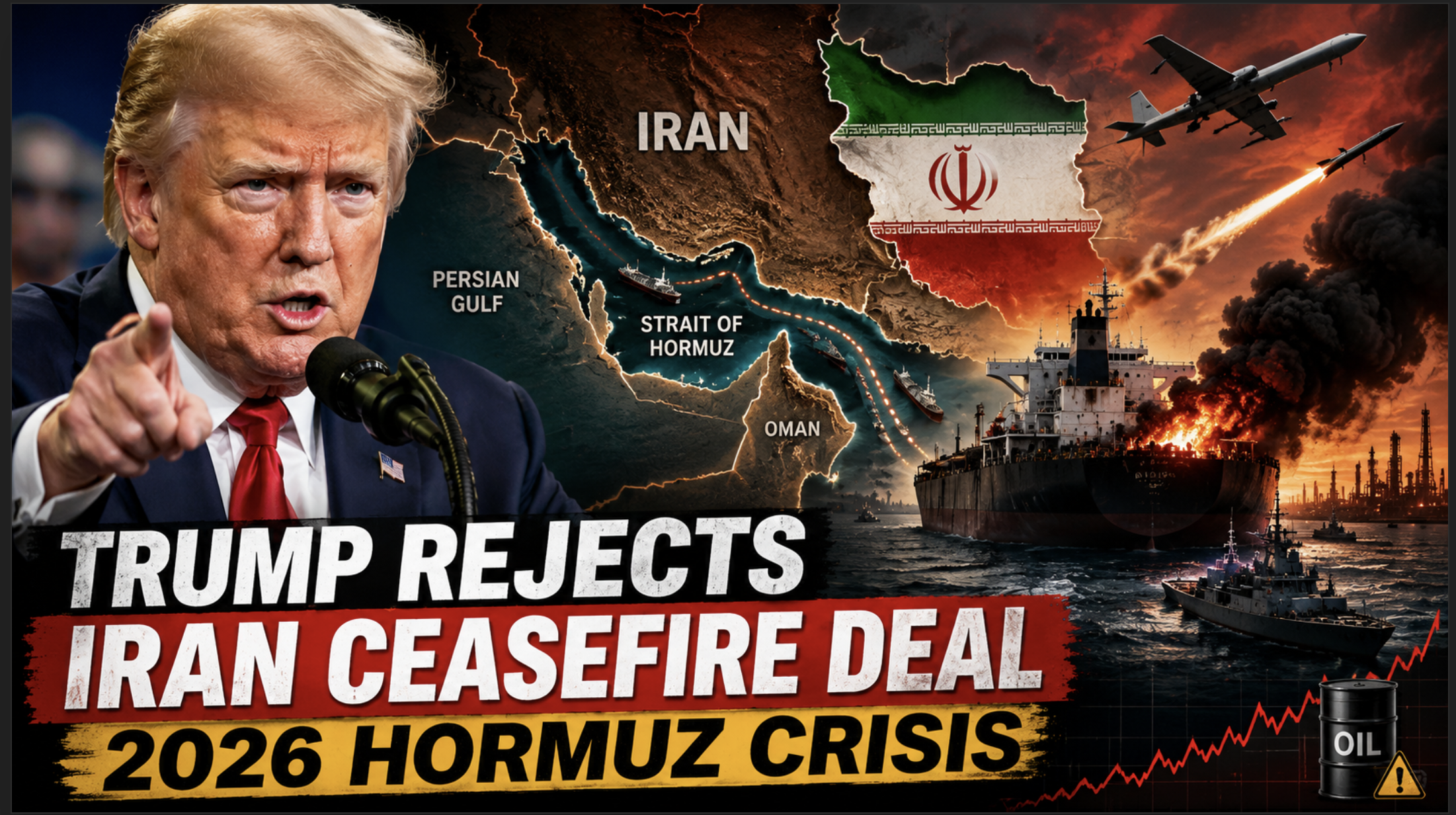
Trump Rejects Iran Ceasefire Deal as Middle East Crisis Deepens
Trump Rejects Iran Ceasefire Deal at a moment when the global economy is already on edge and the Middle East stands dangerously close to a wider regional war.
Late Sunday night, President Donald Trump sharply dismissed Iran’s latest counterproposal aimed at ending the conflict that erupted on February 28. In two aggressive social-media posts, Trump described Tehran’s terms as “TOTALLY UNACCEPTABLE” and accused Iran of “playing games with the United States, and the rest of the world.”
The rejection came despite a fragile ceasefire already being partially observed across parts of the region. Behind the scenes, however, diplomats, intelligence agencies, and military officials continued urgent negotiations as missile strikes and maritime attacks persisted around the Strait of Hormuz.
According to reports carried by Iran’s state-run media outlets, Tehran’s proposal demanded several major concessions before any permanent ceasefire could take effect.
These included:
- Complete lifting of U.S. sanctions
- Removal of the American blockade on Iranian ports
- Release of frozen Iranian assets
- Restoration of unrestricted oil exports
- Reciprocal maritime access through the Strait of Hormuz
- Broader negotiations on ending regional military operations
While the proposal appeared straightforward on paper, Washington and Jerusalem viewed it as strategically unacceptable.
For the United States and Israel, granting sanctions relief before addressing Iran’s nuclear infrastructure and proxy militias would weaken the very leverage created through months of military and economic pressure.
Why Trump Rejects Iran Ceasefire Deal
The reason Trump Rejects Iran Ceasefire Deal is tied directly to the original objectives of the U.S. military campaign launched earlier this year.
Washington’s operation had three primary goals:
1. Cripple Iran’s Nuclear Program
The White House argued that Iran was moving dangerously close to weapons-grade nuclear capability. Western intelligence agencies reportedly assessed that Iran’s enriched uranium stockpile had already reached levels approaching 60 percent purity before the latest escalation.
Experts have repeatedly warned that this enrichment level dramatically shortens the timeline needed to produce bomb-grade material.
For more background on uranium enrichment standards, visit the International Atomic Energy Agency (IAEA).
2. Destroy Iran’s Missile Capabilities
The United States and Israel also aimed to weaken Iran’s ballistic missile and drone infrastructure after repeated regional attacks involving proxy forces and advanced missile systems.
Iran’s missile network remains one of the largest in the Middle East.
Additional defense analysis can be found at the Center for Strategic and International Studies (CSIS).
3. Cut Off Proxy Militias
Washington has long accused Tehran of financing and arming groups such as Hezbollah and the Houthis.
The U.S. position remains that sanctions relief would simply refill Iran’s financial reserves and strengthen these regional proxy organizations.
Strait of Hormuz Crisis Sends Shockwaves Through Global Markets
One major reason Trump Rejects Iran Ceasefire Deal is the strategic importance of the Strait of Hormuz.


The Strait of Hormuz remains one of the world’s most critical energy chokepoints.
According to the U.S. Energy Information Administration (EIA), nearly one-fifth of the world’s daily oil supply normally passes through the narrow waterway.
When Iran restricted commercial shipping following the February conflict:
- Tankers stopped operations
- Shipping insurance costs surged
- Oil prices spiked globally
- Fuel prices rose across Europe and North America
- Supply chains faced immediate disruption
In response, the United States imposed its own naval blockade on Iranian ports.
This mutual economic pressure transformed a regional military conflict into a global energy emergency.
Israel’s Warning: “There Is Still Work To Be Done”
Israeli Prime Minister Benjamin Netanyahu reportedly reinforced Israel’s position during a phone call with Trump on Sunday.
Netanyahu emphasized that Iran had not:
- Surrendered enriched uranium stockpiles
- Dismantled underground nuclear facilities
- Ended support for proxy militias
Israel’s intelligence community continues to argue that temporary ceasefires without permanent nuclear restrictions merely delay future conflict.
That concern explains why Israeli officials strongly supported Trump’s rejection of Iran’s latest proposal.
Iran Continues Maritime Threats in the Gulf
Iranian military officials simultaneously issued warnings to countries assisting U.S. sanctions enforcement.
Tehran warned that vessels connected to sanction enforcement efforts could “face problems” while operating near the Strait of Hormuz.
Recent weeks have already seen:
- Drone attacks on shipping lanes
- Missile strikes near commercial routes
- Explosions involving oil tankers
- Increased naval patrols by regional powers
The maritime situation remains extremely volatile.
Iran Nuclear Concerns Remain Central to the Crisis
At the center of why Trump Rejects Iran Ceasefire Deal lies one core issue: Iran’s nuclear ambitions.


Trump withdrew from the 2015 Iran nuclear agreement during his first presidency because he believed the deal provided sanctions relief without permanently stopping Iran’s nuclear development.
Critics of the original agreement argued that it only delayed Iran’s progress rather than eliminating the threat.
The current administration appears determined not to repeat that approach.
For official background on the previous nuclear agreement, visit the U.S. Department of State.
Global Oil Markets Fear a Massive Economic Shock
The global economy is already feeling the consequences of the Hormuz disruption.
Energy analysts warn that prolonged instability could:
- Push crude oil prices dramatically higher
- Increase inflation worldwide
- Damage post-pandemic economic recovery
- Trigger recession fears in vulnerable economies
Meanwhile, Iran itself faces severe economic pressure.
Reports indicate growing shortages, currency instability, and rising public frustration inside the country.
Still, Iranian hardliners appear willing to endure economic pain if it preserves strategic leverage.
Historical Comparison: The Tanker War Returns
The current crisis has drawn comparisons to the infamous “Tanker War” during the 1980s Iran-Iraq conflict.


During that period:
- Oil tankers faced repeated attacks
- Insurance costs skyrocketed
- The U.S. Navy escorted commercial vessels
- Global energy markets experienced major instability
However, analysts warn that today’s crisis is far more dangerous because of:
- Advanced drone warfare
- Precision missile systems
- Cyber warfare capabilities
- Nuclear escalation risks
The speed of modern military escalation makes the current confrontation significantly more unpredictable.
Why Trump Rejects Iran Ceasefire Deal Could Shape the Entire Region
The latest developments suggest neither side is preparing to compromise soon.
Trump’s statements indicate Washington intends to maintain pressure.
Iran continues insisting on sanctions relief before making nuclear concessions.
Israel remains committed to preventing Tehran from preserving strategic military capabilities.
This creates an extremely dangerous deadlock.
What Happens Next?
Several possible scenarios could emerge:
Diplomatic Breakthrough
International mediators could eventually negotiate a phased agreement involving partial sanctions relief tied to verified nuclear restrictions.
Prolonged Economic Warfare
Both sides may continue blockades and sanctions while avoiding direct full-scale war.
Regional Military Escalation
Further attacks in the Strait of Hormuz could rapidly expand into a broader Middle East conflict.
Oil Market Crisis
Extended shipping disruptions may trigger a major global energy shock affecting fuel prices worldwide.
Final Analysis
The reason Trump Rejects Iran Ceasefire Deal goes far beyond political messaging.
The current confrontation represents a larger struggle over:
- Nuclear deterrence
- Regional influence
- Global energy security
- Middle East military balance
For the United States and Israel, accepting Iran’s current terms without permanent nuclear restrictions risks repeating past mistakes.
For Iran, surrendering leverage without sanctions relief threatens economic collapse and strategic defeat.
The result is a dangerous standoff where neither side appears willing to blink first.
If diplomacy fails to produce a formula combining immediate de-escalation with verifiable nuclear limitations, the current ceasefire may only become a temporary pause before a much larger conflict.
The stakes now extend far beyond the Middle East.
Global oil prices, international shipping, financial markets, and regional stability all depend on what happens next in the Strait of Hormuz crisis.

3 thoughts on “Strait of Hormuz Crisis 2026: Global Energy and Security Implications”